
Kumar Madhusudan, Senior Director – Programmes at ARMMAN, explains why JANANI’s success will be determined not by the platform itself, but by the training, support, and confidence of the health workers who must use it every day.
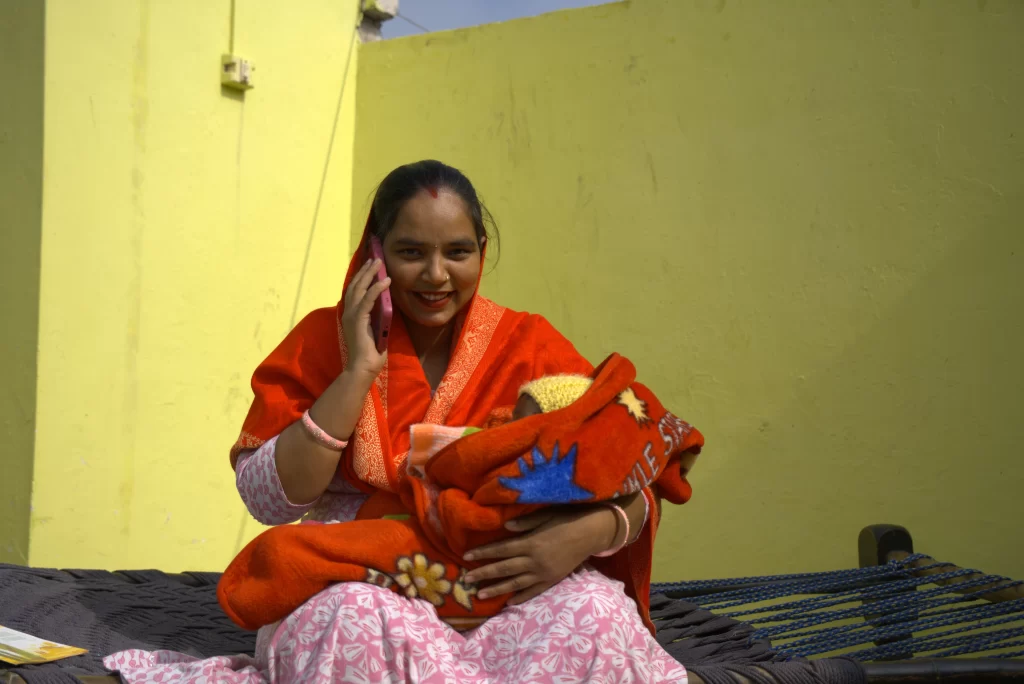
A young mother registers for antenatal care in her first trimester, the first step towards earning her a Mother and Child Protection (MCP) card. She is meant to return for at least three more check-ups before delivery, but it is the Accredited Social Health Activist (ASHA – frontline health worker) supporting her who notices the moment one is missed and follows up without delay. Elsewhere, another health worker, the Auxiliary Nurse Midwife (ANM) flags a high-risk pregnancy before it becomes an emergency. After delivery, a health worker checks on mother and newborn within two days, and in the months that follow, the child receives scheduled vaccination on time, recorded carefully to ensure complete immunisation.
These are the everyday moments that make up India’s maternal and child health system, and behind every one of them is data. When that data is accurate, accessible, and connected, it helps ensure no woman or child falls through the cracks.
According to the National Family Health Survey 2023-24 (NFHS-6), 76.2% of mothers now have their first antenatal check-up within the first trimester, up from 70.0% in NFHS-5, and 95.6% of registered pregnancies already receive a Mother and Child Protection (MCP) card.
Yet there is more progress to be made, and much of it depends on addressing one persistent gap: data scattered across paper registers and disconnected digital platforms.
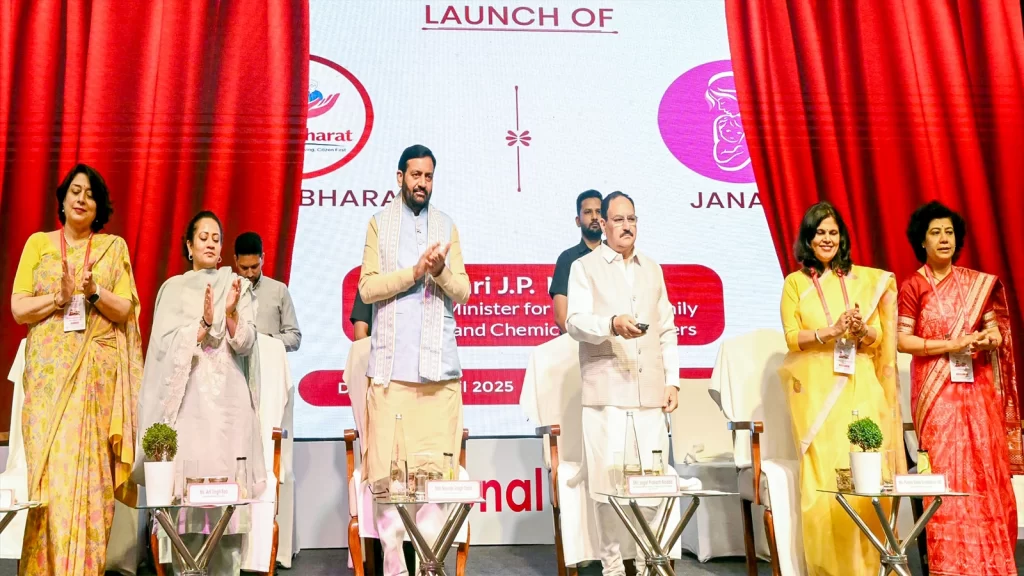
The Government of India launched JANANI (Journey of Antenatal, Natal and Neonatal Integrated Care) in May 2026, a maternal and child health platform designed to comprehensively monitor and maintain digital health records of women during their reproductive age. Developed as an upgraded version of the existing national Reproductive and Child Health (RCH) portal, JANANI creates a longitudinal digital health record by capturing key service-delivery events across the maternal and child health continuum of care.
Addressing data gaps and inaccuracy
When ARMMAN began implementing Kilkari, the world’s largest maternal messaging programme, in partnership with the Ministry of Health and Family Welfare (MoHFW), Government of India in 2019, we experienced the data gaps in real time, affecting the listenership of our Interactive Voice Response (IVR) calls to the target demographic. Inaccurate phone numbers, names and other important details meant that many women who could seek support from the critical life-saving information given through these calls, were not receiving them.
Having identified this gap, we have supported the Government of India for almost a decade now in improving the quality and accuracy of data in the RCH portal, which has a cascading effect resulting in women receiving benefits of more Government schemes.
JANANI is a boost in the arm, representing one of the most significant structural reforms in India’s maternal and child healthcare space in recent years, digitising medical records and aiming to ensure continuous, accessible care for women and children. In practice, this means that pregnant women and mothers in India, will, for the first time, have a single, traceable digital health record, covering pregnancy, delivery, the weeks after birth, newborn care, and family planning.
Nationally, only 65.2% of mothers complete the four or more antenatal visits recommended during pregnancy (NFHS-6), up from 58.5% in the previous survey, but still leaving considerable room for improvement. This is because the JANANI’s automated alerts and due-list generation are designed to close, by making it easier for a health worker to see, at a glance, which women need a visit or a reminder.
However, without adequate training, handholding, and continuous support, even a well-designed platform like JANANI risks becoming another data-entry exercise rather than the service-delivery tool it was meant to be. Its success will not be measured by registrations completed or dashboards built, but by something simpler: pregnant women, mothers, or children missed across the continuum of care.
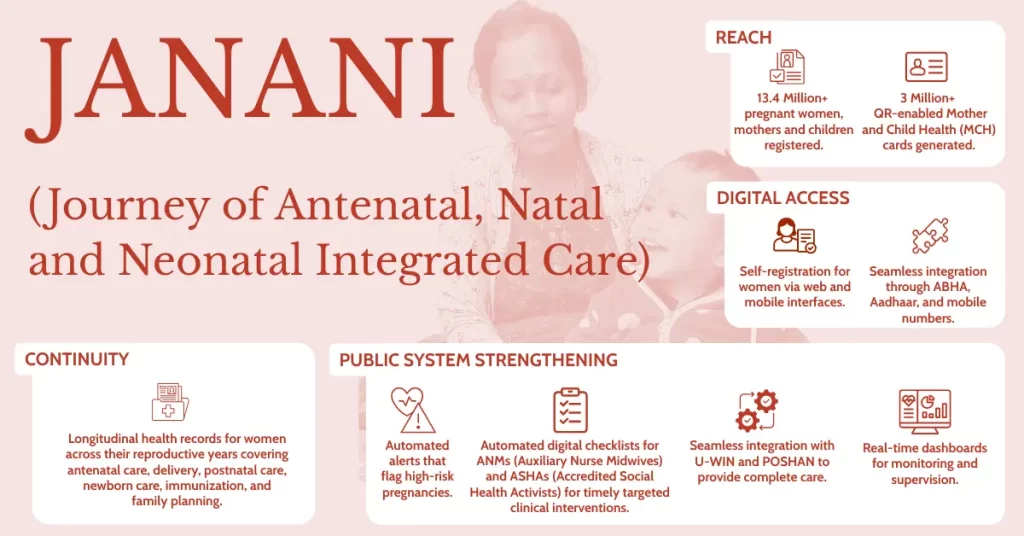
Key Features of the JANANI Portal
The Real Challenge: Last-Mile Adoption
Launching a digital platform is the easy part. The harder, less visible test is adoption.
JANANI must move through several phases before it becomes second nature to the people using it. Health workers need training. Registration and basic details are a one-time update, but service-level data, the specifics of each visit, must be captured every single time a beneficiary accesses care, a significant daily workload for a health worker already managing dozens of cases.
Moving from the RCH Portal to JANANI also means adapting to new workflows, authentication processes, and data standards, all while continuing to deliver care without interruption. If an ANM feels the platform is simply adding to her workload, without visibly reducing duplicate work or offering real benefits in return, resistance is a natural response, not a failure of intent. In rural and tribal India, patchy internet connectivity, device shortages, and unreliable power supply make real-time data entry harder still, leading to delayed updates or incomplete records through no fault of the health worker involved.
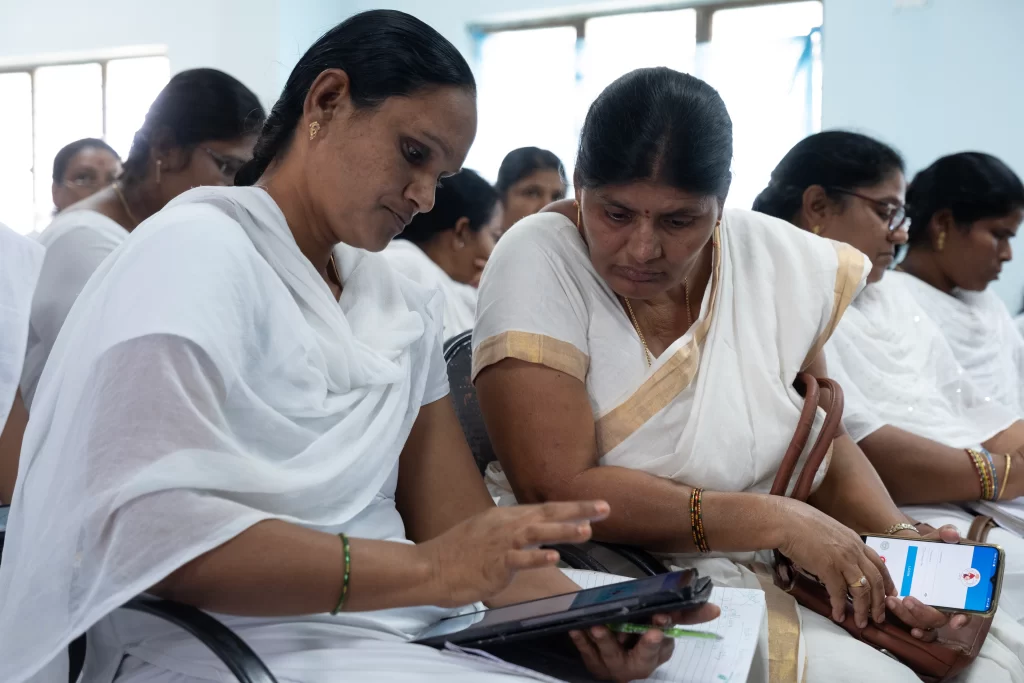
Enabling seamless transition to JANANI
ARMMAN has spent more than a decade working to close exactly this kind of gap between technology and the people who must use it. Much of this experience comes from our high risk pregnancy programme (Integrated High Risk Pregnancy Tracking and Management), through which we train ANMs and Medical Officers to identify, track, manage and refer high-risk pregnancies, many of the same skills now central to JANANI’s national rollout.
On-Ground Support
As one of the development partners working alongside RCH data teams across the country, ARMMAN brings hands-on support to help JANANI take root in the daily routines of frontline health workers. This work includes:
- Training ANMs and other data-entry personnel on the new platform
- Supporting ANMs with application installation and onboarding
- Resolving technical and operational challenges as they arise, often in real time
- Providing ongoing, day-to-day troubleshooting for data-entry teams
- Improving coordination across block, district, state, and national levels for faster issue resolution
What sets this work apart is its focus: not simply introducing new technology, but supporting a health worker, patiently, as many times as it takes, until she feels confident using the platform as part of her routine rather than an added burden.
Strengthening Public Health Systems from Within
It is tempting to view digital health platforms purely as technology stories. But JANANI’s value will not be measured in lines of code. It will be measured in the number of high-risk pregnancies detected early, the number of mothers who never have to repeat their medical history at a new facility, and the number of children whose immunisation records never get lost.
Full childhood immunisation in India has climbed to 82.6%, up from 76.6%, and postnatal care for newborns within two days of birth now reaches 85.3% of children, up from 79.1%. Milestones like these depend on a child’s record following them seamlessly from one visit to the next.
Realising that vision takes more than software. It takes trained health workers who trust the tools they are given, responsive support systems, and sustained implementation effort at every level of the system, from a single Anganwadi centre to the national health ministry. This is where ARMMAN plays a critical role, not by replacing the public health system, but by strengthening it from within. Because the true measure of any digital health platform is never the technology it introduces. It is the lives it helps improve.
Be Part of This Story
JANANI is more than a government IT upgrade. It is a chance to make sure that every mother and child in India is seen by the health system meant to protect them, something that only becomes real when frontline health workers have the training, support, and confidence to use it well, every single day.
ARMMAN has spent over 17 years working at this intersection of technology and grassroots healthcare, reaching millions of women and training thousands of frontline health workers across the country. If you would like to learn more about our work, support our programmes, or explore a partnership with ARMMAN, we would love to hear from you.
Visit armman.org to learn more about our work in maternal and child health.
Frequently Asked Questions
What is JANANI?
JANANI (Journey of Antenatal, Natal and Neonatal Integrated Care) is the Government of India’s maternal and child health platform built on the upgraded RCH 2.0 system. It creates digital health records that support continuity of care from pregnancy through early childhood.
How is JANANI different from the previous RCH Portal?
JANANI introduces longitudinal digital health records, QR-enabled Mother and Child Health Cards, automated alerts for high-risk pregnancies, interoperability with national health platforms, and improved beneficiary tracking across facilities.
Why is JANANI important for maternal and child health?
JANANI helps frontline health workers track beneficiaries more effectively, identify high-risk pregnancies earlier, reduce missed services, and improve continuity of care across the maternal and child health journey.
What is ARMMAN’s role in the JANANI transition?
ARMMAN supports the rollout of JANANI by training frontline health workers, assisting with onboarding and troubleshooting, strengthening coordination across health system levels, and helping states adopt the platform effectively.
How does JANANI support programmes like Kilkari?
JANANI improves the quality and accuracy of beneficiary data, enabling programmes such as Kilkari to deliver timely, stage-specific health information to women during pregnancy and early childhood.